Thursday, 10 December 2020

15 of the Best Holiday Marketing Campaigns (And What You Can Learn from Them)

Congrats, you’ve survived Black Friday and Cyber Monday! Naturally, this can only mean that the holiday season is upon us once again. As a result, it’s time to prepare for your holiday marketing campaigns.

This season offers a lot of opportunities for all businesses, big and small. If you can grab consumers’ attention with a unique holiday marketing campaign, you’ll be well on your way to pulling in additional revenue. A smart place to start is to look at what has worked for other brands and then use their campaigns as inspiration for your own marketing efforts.

In this article, we’ll take a look back at some of our favorite marketing campaign ideas from seasons past. We’ll discuss their history, why they were so successful, and how you can incorporate them into your holiday marketing strategy. Let’s jump right in!

Your Site’s Home for the Holidays

We make sure your website is fast, secure and always up so your visitors trust you. Plans start at $2.59/mo.

 

1. “Santa Tracker” by Google
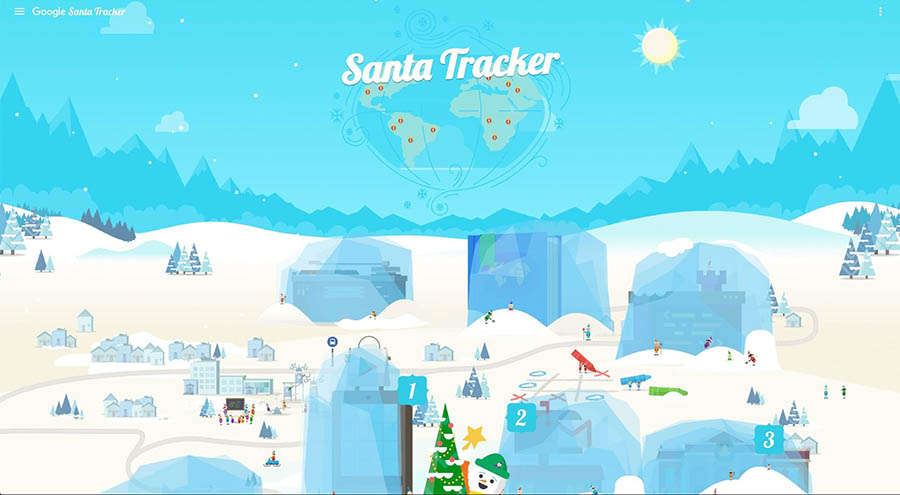
Google’s Santa Tracker website.

We’re going to start with a true classic of online holiday marketing. Google’s Santa Tracker has been going strong since 2004. During this time, it has enabled users to follow Santa Claus on his worldwide gift-giving journey every Christmas.

The Santa Tracker campaign initially started as a simple way to visualize Santa’s journey via Google Earth (or Keyhole Earth Viewer, as it was called then). However, it has since evolved in numerous ways. For instance, the site has expanded to show information about the cities Santa visits, offer “live updates” directly from the sleigh, and much more.

With Santa Tracker, Google manages to market its map service in a way that is both fun and interactive. The key lesson to take away from this marketing campaign is that it works across multiple audience segments, appealing equally to young children and adults. By combining mythology and technology in a quirky way, Google managed to create a new spin on an age-old story and make its brand synonymous with the tradition itself at the same time.

2. “Elf Yourself” by Office Depot

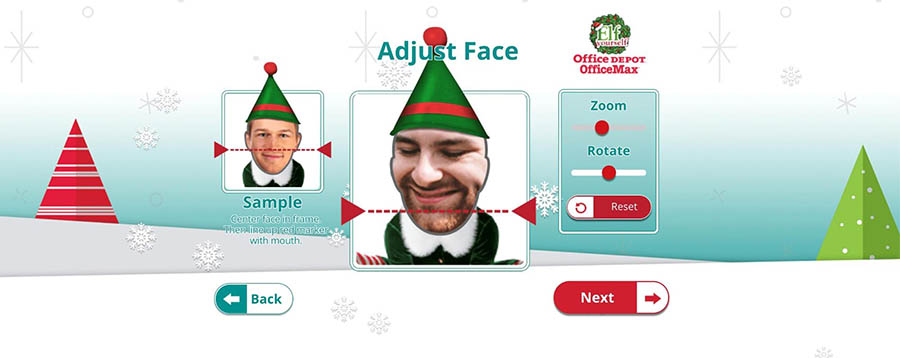
Using the Elf Yourself website to create an elf.

Next up, this is another interactive and playful campaign that appeals to kids and adults alike. Elf Yourself is a recurring campaign by Office Depot, which lets users create elves based on pictures of themselves (or other people). Since 2006, users have created over one billion elves using the site and app.

In recent years, the Elf Yourself app has been updated with new features, such as Augmented Reality (AR) and the ability to print your elf as a seasonal greeting card. Users can also share their creations on social media, along with the marketing hashtag #ElfYourself.

This is an example of how a holiday campaign can be used to grow brand awareness, rather than explicitly aiming to increase conversions or sales. By providing something fun and engaging for your users to play with, you can get the word out about your business, without overtly promoting your products or services.

3. “Home Alone, Again” by Google

Google’s “Home Alone Again” video.

Nostalgia can be an excellent driver of shareable content. That’s what Google’s 2018 advertisement  “Home Alone Again” took advantage of. The video, featuring a grown-up Macauly Culkin, tapped into a wealth of holiday feelings. Created by the Arts & Letters firm and directed by Mike Warzin via Arts & Sciences, the short video also features all the best of Google Assistant

The scenes and overall general feeling of the video are designed to be transportive for anyone who grew up watching the Home Alone films as a holiday staple. Google Assistant starts off by reminding “Kevin” that he finally has the house to himself for the day and organically showcases its smart home options when the bad guys enter the picture. 

This ad taps into a piece of media that many generations have enjoyed. The original movie debuted in 1990, meaning it’s likely that the ad will hit home with audiences ranging from baby boomers to millennials. Wrapping your ads around something very nostalgic to your audience is a marketing approach that can have shareable appeal across platforms and generations.

Want More Holiday Marketing Advice?

We've got you covered! Subscribe to our monthly newsletter so you never miss an article.

4. “The Holiday Odyssey” by Target

Screenshot from Target’s Holiday Odyssey advertisement.

In a sense, every holiday season is a journey. At least, it is if you believe Target and its 2015 campaign “The Holiday Odyssey.” This campaign’s most visible element was a series of short video clips, which included cameos from the Minions, Barbie, Star Wars characters, and even Neil Patrick Harris.

However, these storytelling videos only represented one aspect of the campaign, which also made use of multiple marketing channels. As well as a dedicated website and promotion across its social media platforms, Target also took the “Odyssey” into its physical stores. By doing this, Target managed to create a complete synergy across multiple platforms, something that’s ideal for businesses with a broad audience.

This is naturally difficult to do if you don’t have the reach and budget of a major corporation. Still, it does highlight the importance of leveraging multiple channels in your own marketing. 

Sure, you might not be able to afford to feature NPH in your ads. However, you can still use your online presence and physical stores in conjunction to create an all-encompassing campaign that appeals equally to the various segments of your audience.

5. “Nick Offerman’s Yule Log” by Lagavulin

Screenshot of Lagavulin’s Yule Log video, starring Nick Offerman.

Watching a man silently drink whiskey next to a crackling fireplace for 45 minutes might not sound very appealing at first. However, if that man is actor and comedian Nick Offerman, you’ve got a viral marketing sensation on your hands.

That’s what Lagavulin did when it hired Offerman to create a parody of the “classic” yule log videos that were popular in 2015 (and still are). Since then, the original video has been watched over 3 million times. Thanks to popular demand, Lagavulin has even put out an extended 10-hour version.

This campaign is a masterclass in how to use a video to create a conversation starter. First, it’s a perfect fit with Offerman’s existing public persona and ties into his most famous role as Ron Swanson on TV show Parks & Recreation, a character who famously loved Lagavulin.

However, it’s also an eminently shareable clip in its own right. It’s fun, attention-grabbing, and actually works quite well as a non-ironic yule log video. Considering the minimal resources required to pull this off, it’s a perfect example of how a simple idea can have a huge payoff if it connects with your audience.

6. “Red Cups” by Starbucks

Holiday cups offered by Starbucks.

In a previous article, we discussed Starbucks’ penchant for brand management on its official company blog. To no one’s surprise, it turns out that the company is just as proficient at promoting its brand during the holiday season. You’ve most likely seen its iconic holiday cup designs yourself — they were introduced all the way back in 1997.

Since then, the company has featured new festive designs every year. Somewhat infamously, these cups were a point of controversy in 2015, when a plain red variety was accused of not being “Christmassy” enough. Despite this setback, the reusable red cup design has become iconic, to the point where independent websites have sprung up that feature a countdown to its annual re-release.

The lesson here is that a stylish and cohesive brand identity can be an extremely powerful tool. This campaign also shows that it’s possible to create unique traditions that are tied to your brand, then encourage your audience to look forward to them each year.

7. “#OptOutside” by REI
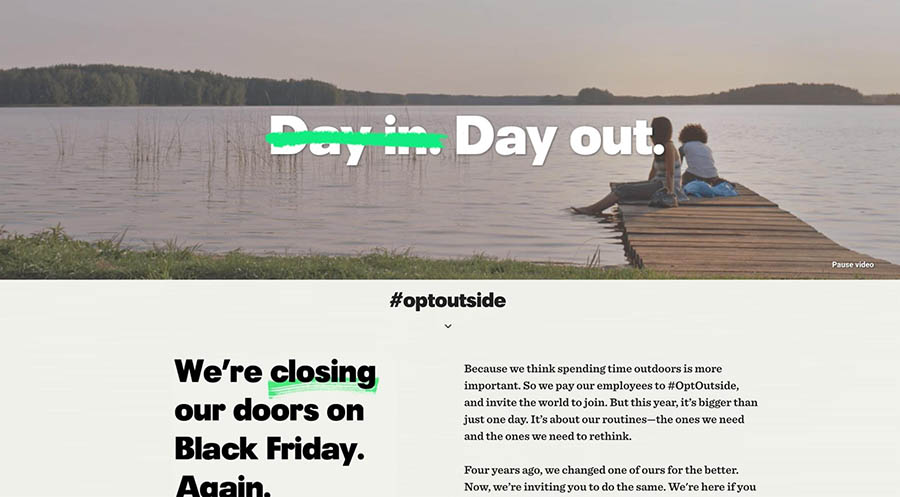
The #OptOuside page by REI.

Black Friday is widely regarded as the beginning of the holiday shopping season, as well as one of the busiest retail days around the world. Considering this fact, it was especially noteworthy when the outdoor retailer REI announced that it would not participate in the Black Friday rush of 2015 and would keep all its stores closed for the entire day.

This was the start of the #OptOutside campaign, which has become a recurring event ever since. The goal was to get employees and customers to spend Black Friday enjoying the outdoors rather than shopping. After the initial success, the company has expanded the event to include a search engine that lets users around the world share their outdoor experiences using the campaign’s hashtag.

Not only is #OptOutside a terrific example of a company making a statement about the holidays, but it’s also perfectly in line with its brand identity. After all, REI sells outdoor equipment, so it makes sense to encourage people to participate in outside activities even during the winter. This goes to show that you can start a meaningful conversation while also bringing attention to what your business does best. 

8. “Misunderstood” by Apple

Screenshot of the ‘Misunderstood’ short film by Apple.

Whether it’s spending time with family and loved ones or remembering past holidays, the festive season is steeped in sentimentality. Many businesses take advantage of this in their campaigns, and perhaps the best example is Apple’s short film, Misunderstood.

The clip shows a young boy appearing to avoid spending time with his family during the holidays. However, at the end (spoilers!), it’s revealed that he was actually busy creating a heartwarming montage of family moments the whole time. The clip was positively received by many viewers and even went on to win an Emmy.

With this clip, Apple managed to insert its product into the sentimentality of the season in two clever ways. The film subverts the idea that phones are only used to avoid time with your family, while also demonstrating the actual capabilities of the latest iPhone at the same time. This is a “show, don’t tell” approach to marketing a specific product that can be difficult to pull off, but very effective when done well.

9. “#NZSecretSanta” By New Zealand Post
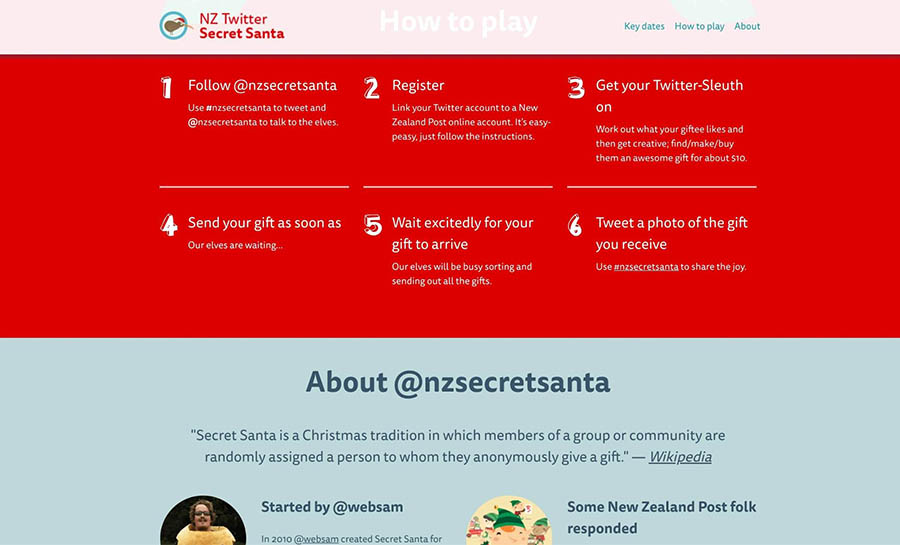
The #NZSecretSanta home page.

In case you’re not familiar with the concept, Secret Santa is a tradition where a group of people comes together to buy one gift for each person — everybody buys and gets a gift. However, each recipient is entirely unaware of who their gift-giver is, which creates a fun sense of mystery.

With its #NZSecretSanta event, the New Zealand Post aimed to blow this game up to a national level. Started in 2010 by Sam Elton-Waters, the initiative was a huge success — even the country’s prime minister took part! As the yearly event grew in scope, the New Zealand Post stepped in to help organize the gift-giving.

Not only is this a heartwarming tradition, but it’s also a great example of how you can engage people using social media campaigns. An event that encourages people to have fun together, be thoughtful, and even give to charity helps to encourage participation and positive feelings towards your business.

10. “Come Together” by H&M

Screenshot from H&M’s Come Together short film.

At this point, we’ve already mentioned the benefits of using video marketing to your advantage during the holidays. However, we’d be remiss if we didn’t also bring up H&M’s impressive “Come Together” campaign.

Directed by Wes Anderson, this short film features Adrien Brody as a conductor on a train that gets caught in a snowstorm. Since they’re stuck in place, the conductor and passengers decide to throw a Christmas party together. Shot in the filmmaker’s trademark style, the video is both quirky and heartwarming. It also aligns the brand with Anderson’s sense of fashion and whimsy. 

This is yet another way you can create a talking point, even if you don’t have any Academy Award-winning actors at your disposal. You can still use your brand videos to create a unique signature and style. Having a recognizable style is crucial during the busy holiday season and is especially important for brands aimed at a modern, trend-conscious audience. 

11. “Believe” by Macy’s
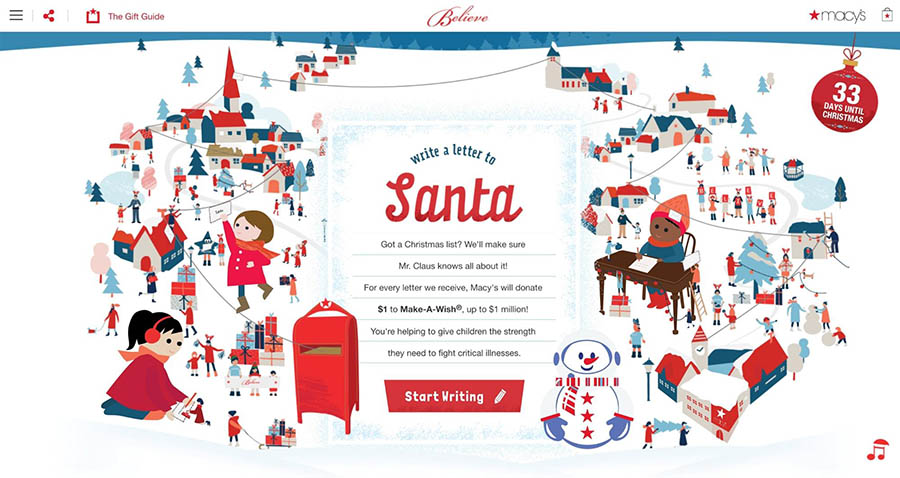
The home page for Macy’s Believe campaign.

Think fast: What are the two most essential parts of Christmastime? If you answered “stuffing your face with food” and “decorating the tree,” we can’t blame you. However, we were specifically thinking of charity and gift-giving. 

Charity is an especially significant part of the holiday spirit, and it’s something Macy’s has made a cornerstone of its “Believe” campaign. This campaign revolves around a site where users can write a letter to Santa with their Christmas wishes. For every letter posted, Macy’s donates $1 to the Make-a-Wish foundation.

Not only does this charitable element align perfectly with the giving season, but it also encourages visitors and customers to engage with the brand directly. This type of initiative lets you do a charitable deed while also expressing your brand identity in a fun and memorable way.

12. “Holiday Gift Guides” by Etsy

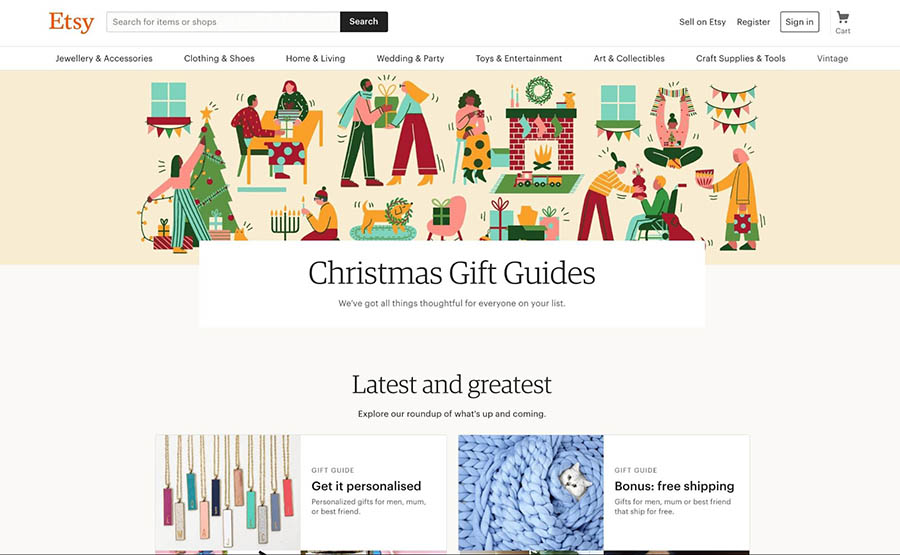
Holiday gift guides on the Etsy home page.

Most of the campaigns we’ve looked at have avoided being directly commercial in nature. Instead, many businesses choose to use the holiday season to manage and increase awareness of their brands, rather than actively pushing their products.

However, Etsy manages to go another way while also providing useful content for its users. Instead of a big marketing push, this e-commerce site produces annual “Gift Guides.” These guides help holiday shoppers find the perfect presents to buy, based on different categories and styles.

This is a creative way to drive additional sales while still sticking with a holiday theme. It also helps funnel customers more effectively towards the products they’ll prefer. In fact, Etsy actually provides similar guides all year round, such as the Finds Under $30 guide. This means that loyal customers will already be accustomed to searching for products in the same fashion.

Whether or not you create a dedicated gift guide, it’s key to ensure that your actual website makes it easy for users to find what they need quickly. After all, buying gifts for the holidays is often stressful. Anything you can do to make this process faster and easier is going to be well-appreciated by your customers.

13. “The Book of Dreams” by Argos

The Argos “Book of Dreams” advertisement.

It might seem “old school” to promote a traditional, physical product catalog in our highly-digital age. However, British catalog retailer Argos has found a way to do so successfully. In one of the early holiday ads of 2019, The&Partnership advertising agency created a video that appeals to the child in all of us. 

Dubbed The Book of Dreams, the ad follows a dad reliving a childhood dream about a drumset as the scene around him transforms into a stage. He’s joined by his daughter, and they rock out to “Don’t You Forget About Me” by Simple Minds. In a successful play on nostalgia and recapturing the wonder of the holidays, the advertisement is sweet and highly shareable.  

Harnessing the magic of being a child at Christmastime is something any holiday campaign can strive for. Plus, this example demonstrates that the excitement of thumbing through a toy catalog is a unique and tangible joy that can be tied to fun online content. When customers receive the mailing, they’ll remember to dream big!

14. “All Together” by Amazon
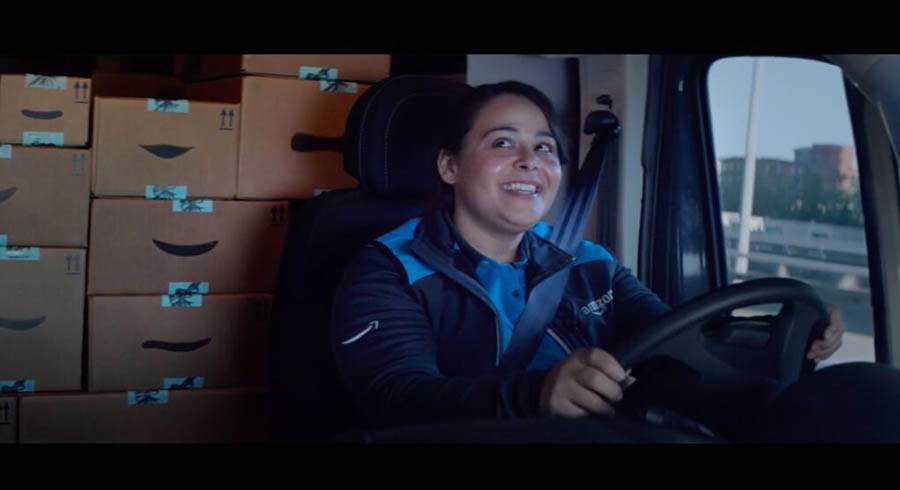
Alt-text: An Amazon holiday video advertisement.

From the Lucky Generals agency, this next piece of Christmas marketing brings everyone a smiling box and a catchy tune. Amazon’s All Together advertisement highlights the company’s employees and friendly packaging in a video reminiscent of the popular holiday film Love Actually

In terms of takeaways, this is another excellent example of how to demonstrate a lot of different aspects of your business in a minute or less. You can highlight your employees, your customers, and just average people being happy and connecting with others. It only takes Amazon 90 seconds to make you want to call your mother, which highlights the impact of a heartfelt approach.

This particular video demonstrates the value of going all the way and embracing the touchy-feely part of the holiday season without cynicism or parody. Showcasing the excitement of the holidays — and working in your products or services organically without letting them steal focus — is a recipe for success with this type of marketing.

15. “Holidays Are Coming!” by Coca-Cola

Screenshot from the Holidays Are Coming advertisement by Coca-Cola.

Finally, let’s end on a true classic, perhaps the most legendary and recognizable holiday campaign in media history. Coca-Cola has been crucial in defining how Christmas marketing looks to the point where a prevalent myth claims that the company invented the modern image of Santa Claus.

Even if that’s not true, Coca Cola’s recurring “Holidays Are Coming” campaign is still legendary. In fact, many don’t consider the Christmas season truly started until they hear the familiar jingle on TV. Even though it’s been a staple for over two decades, Coca-Cola has continued to expand and innovate its holiday marketing, while still keeping the core of its message clear and consistent.

After all, the holidays are all about traditions, both big and small. Using nostalgia and tried-and-true concepts can help to create a sense of tradition around your brand. We’ve seen this notion applied in many of the campaigns on this list, where brands iterate on a successful idea over the years.

However, nothing demonstrates the effect of this technique quite like Coca-Cola. If you can manage something similar for your own brand, albeit, on a smaller scale, it can improve your business’ authority and capture your audience’s imagination.

Holly and Jolly

The holidays are not just about giving gifts, traveling, and spending time with family. They’re also a prime opportunity to market your business, boost end-of-year sales, and solidify your brand identity in the process. 

Making sure you have all the tools you need can help boost the success of any campaign. Our shared hosting is a great way to get started on a new endeavor while providing your site with lots of room to grow!

The post 15 of the Best Holiday Marketing Campaigns (And What You Can Learn from Them) appeared first on Website Guides, Tips & Knowledge.


source https://www.dreamhost.com/blog/best-holiday-marketing-campaigns/

Monday, 7 December 2020

25 Simple Ways To Boost Holiday Sales on Your Website

The holiday season is a critical time for retailers, with some making a good chunk of their yearly revenue in just a couple of months.

And while 2020 has been a proverbial “lump of coal” for small business owners, with many having to pivot to curbside pickup or go digital with their services, there’s good reason to believe that we’re on the cusp of a [insert your holiday of choice] miracle.

As we covered in our 2020 Black Friday and Cyber Monday shopping guide, consumers are very eager to spend money on some holiday cheer this December. And you should use that to your advantage!

Below, we’ve outlined 25 tried-and-tested tips for boosting your online sales this winter. Our advice falls into three main categories:

So are you ready to tie a bow around 2020? If so, read on to find out how your online store can get more traffic, increase sales, and improve customer experience this month.

Your Website’s Home for the Holidays

We make sure your website is fast, secure, and always up during the holiday shopping season and beyond. Plans start at $2.59/mo.

On-Site Tweaks

1. Optimize your copy

This applies to every page of your site — from your homepage to your About Us page, and of course, your all-important product pages:

  • Detailed product information
  • Persuasive copy
  • Trust factors
  • Calls-to-Action

These are all things that can boost conversion rates, sales, and revenue. Plus, they’ll help you all year round — not just during the holidays.

Not convinced? Think of it this way.

When you’re in a shop, you can look, touch, and feel a product. Depending on the product type, you can often try it on or play around with it.

What’s more, a store’s physical presence creates trust, while sales staff are on-hand to assist customers and encourage them to buy.

All this is lost when shopping online.

Use your online copy to recreate the in-store environment online.

2. Streamline your checkout process

Long, fiddly online checkouts can be a massive barrier to sales. Especially since more than half of internet shopping now takes place on mobile.

If your checkout process asks for too much information or offers a poor user experience, you’re going to lose sales — period.

A good place to start with streamlining your checkout is to test, test, and test again.

Ask friends or family who are unfamiliar with the ins-and-outs of e-commerce and internet marketing to do a test purchase (you can either ask them to complete a purchase and then cancel it or simply not go past the entering-your-payment-details stage).

Then, ask for their feedback:

  • How simple was the process?
  • What, if any, problems did they run into?
  • How does your checkout process compare with other sites they shop from? Ask for specifics — not just “compares well” or “doesn’t compare well.”

Also, consider the following:

  • Do not ask people to register before buying. Give them the option to register, but don’t make it mandatory.
  • Only ask for essential details.
  • Offer multiple ways to pay. Check out our guide to payment gateways for ideas.
  • Make delivery costs clear (and don’t leave it until the last moment to state them).

3. Optimize your site for speed

Site speed, or on a more granular basis, page load speed, is important for two reasons:

  1. SEO: Google has stated that all things being equal, page load speed is a ranking factor.
  2. UX: Longer page load speed = higher bounce rates and fewer sales.

cGoogle’s own PageSpeed Insights will score any page of your site on how quickly (or slowly) it loads and tell you what you can do to improve it. We’ve also written a guide on what you can do to optimize a WordPress site for speed.

4. Get into CRO

CRO (or conversion rate optimization) is the practice of testing and optimizing your site — not to drive more traffic, but to convert more of that traffic into sales.

It is, sadly, a frequently overlooked element of digital marketing. Ideally, it should go hand-in-hand with other digital marketing channels. But this is often not the case.

Priority is typically placed on boosting traffic. And that’s understandable. Why invest in CRO when you have no traffic to convert?

But once you do have a decent stream of traffic coming to your site? Start testing. Start tweaking. And start turning more of your visitors into customers.

5. Upgrade your product visuals and videos

Remember our first point?

Online shopping eliminates the ability for people to see, touch, and try products. The more you can do to replicate the in-store experience, the more money you’re likely to make.

One way to do this is to improve your product photos. Better yet, use videos, too.

Take ASOS. All their product pages feature high-resolution photos from different angles that you can zoom in on. Alongside these are short “catwalk” style videos, enabling shoppers to see how the clothing fits and moves in real life.

Example of ASOS product page listing.

There’s no doubt that the effort ASOS puts into their imagery and video is part of the reason they’re one of the world’s leading online fashion retailers.

6. Simplify your site structure

Simple navigation = more sales. Complicated navigation = fewer sales.

Why? If customers can’t find what they’re looking for, they’re not going to buy it (for obvious reasons).

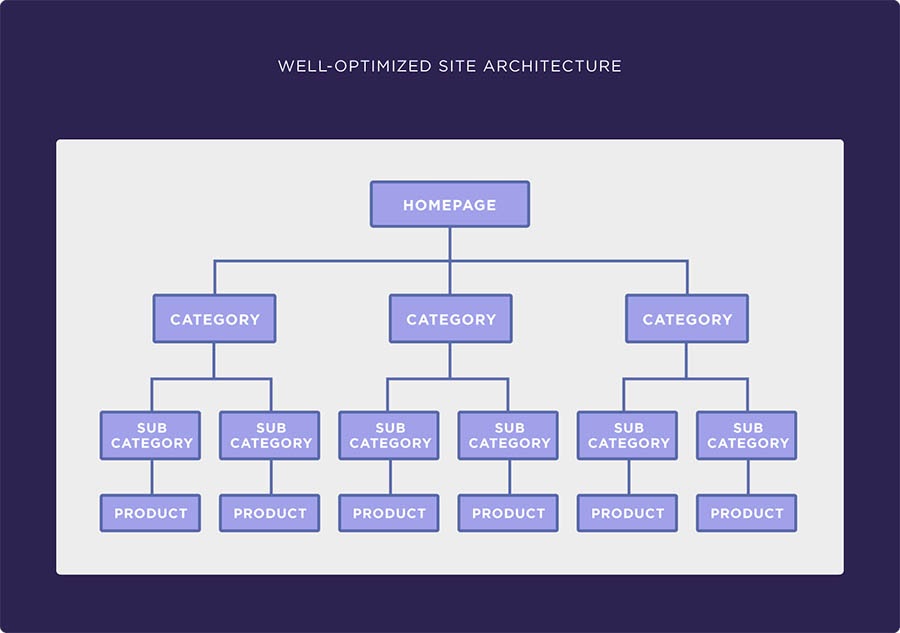
Your site structure can make or break your user experience. But what does a simple site structure look like?

Something like this.

Breakdown of well-optimized site structure.
(Image credit)

You have your homepage. Which leads to your top-level categories. Which leads to sub-categories. Which then include your products.

Of course, this will vary depending on the type of site, your product range, and whether you have products in multiple categories — but this is a pretty typical example, and a solid structure to aim for.

A couple of additional tips on this point:

  • Use breadcrumbs. They help users retrace their steps and easily return to a parent page or category.
  • Make sure your search function works properly.
  • Include filters. They enable users to refine categories and make the online shopping experience easier, faster, and more enjoyable.

7. Give landing pages a festive makeover

This one’s simple, really — you’re preparing your site for the festive season, so why not give it a temporary makeover in celebration?

We’ve got plenty of inspiration for you here.

8. Make sure your hosting can handle a holiday traffic surge

E-commerce sites naturally see a boost in traffic during the holiday season. This is likely to be far more apparent in 2020 — especially in places where non-essential stores are closed due to COVID-19.

Can your site handle that extra traffic? Does it have a limited bandwidth?

An unexpected (or unplanned for) surge in traffic can slow sites down (in turn losing you sales) or break a site altogether.

Consider upgrading your website’s hosting to ensure it can handle the extra demand. This guide can help you determine when to upgrade your site’s hosting.

For online stores, we recommend looking at our WooCommerce hosting services. Starting at $16.95 per month, these plans come with an uptime guarantee, powerful caching, on-demand backups, and 24/7 support from WordPress experts.

9. Make sure your site is mobile-friendly

This is essential whatever time of year. We already know that more than half of online purchases take place on mobile. And now we have mobile-first indexing to consider too.

Basically, if your site isn’t mobile-friendly, the result is most likely going to be lower rankings, less traffic, and fewer conversions.

You can find out if your site makes the grade with Google’s mobile-friendly testing tool.

Another handy tool is Responsive Viewer — a free Chrome plugin that shows how sites look on various mobile devices.

10. Borrow ideas from national brands

Big brands mean big budgets, which in turn, mean (generally) big ideas. And many brands go all out for the holidays.

While financial restrictions may prevent you from creating campaigns on that scale, there’s often a lot you can learn from looking at the marketing strategies of big brands (both inside and outside of your industry).

Marketing Tactics

11. Create bundled promotions

Bundles — a form of upselling — are a big win for both the brand and the customer. The brand sells more stock, and the customer gets more for their money.

What’s not to like?

The only thing to consider is this: What should you include in your bundles?

You shouldn’t try to palm your customers off with a bundle of completely unrelated products. Some companies do this to try to get rid of old stock, but interest will be minimal (if you get any at all).

Instead, create bundles that are going to help customers, and save them time. For example, a “gifts for the whole family” bundle or a “most popular Xbox games of the year” bundle — ideal for lazy customers who just want to get their holiday shopping over and done with!

Too much work?

Here are a few alternatives to try.

  • Offer a discount when a customer buys X number of products or spends X amount.
  • Do a “buy X products, get the cheapest free” offer.
  • Allow customers to create their own bundles.
Example of “Build Your Own Bundle” of Nintendo products.
(Image credit)

12. Offer samples with purchases

This isn’t ideal for all industries, but it’s perfect for companies that distribute consumable products (think beauty products and toiletries, sweets, foods, drinks — anything that can be produced and given away in miniature form).

Simply offer a free sample pack with a customer’s first purchase. Not only is this an incentive to buy, but it can boost your customer return rates, too.

13. Boost traffic with a giveaway

Online competitions are a simple, effective, and (depending on the prize) cheap way to drive traffic and (hopefully) customers to your site. They’re also a great way to expand your email marketing list.

That said, it’s easy to run a competition and see little to no ROI.

Many brands just create a competition page containing a simple question (or no question at all) and an entry form.

Some brands will even host a competition on an external site. This should increase visibility and entrants — which is fine if your only intention is to get more names and addresses on your email list.

But you’re trying to get people to your site, and more importantly, interacting with it. So how do you go about doing that?

You include a question or task that requires entrants to explore your site.

Let’s give you an example.

Since we’re talking about a holiday promotion, you might ask entrants to complete a “wishlist” task. So say your prize was a $100 voucher for the site, you’d ask entrants how they would spend it/what items on your site they would put on their Christmas wish list.

This forces entrants to actually browse through your products, meaning the competition is more likely to drive sales.

14. Partner with micro-influencers

You’ve probably heard about influencer marketing. You’ve probably thought it’s a tactic that’s beyond your reach. But have you heard of micro-influencer marketing?

The name kind of gives it away. Micro-influencers have much smaller social networks than typical, big-name influencers. And that’s a good thing.

Some of the benefits to partnering with a micro-influencer include:

  • More affordable fees.
  • A more niche following — meaning it’s easier to find an influencer with an audience that aligns with your product/s.
  • Less competition with products from other brands (and in turn, higher conversion rates).

15. Create social media ads to promote your deals across all channels

This is an obvious one, but it’s all-the-more important leading up to the holidays. Retailers must maximize the one time of year when consumers everywhere loosen the purse strings. One very effective way to do that is to advertise on social media — especially to promote offers or deals.

Oh, and those competitions we just mentioned.

Just beware that while social media advertising might appear simple, you could lose a lot of money if you get it wrong.

For maximum ROI, you want to ensure you’re targeting exactly the right people. If you don’t know how to do this, either learn or pay an expert to create and manage the ads for you.

Just bear in mind: If you want to teach yourself, you need to check the date on the resources you’re learning from. Social media advertising is in constant flux. Out-of-date resources are largely worthless.

16. Plan your marketing emails

This is another obvious one, and it’s likely something you’re already doing. However, any retailer that fails to make the most of the holiday season is making a big mistake. So plan to send a number of emails, and plan ahead.

Like so:

  1. Learn how to send marketing emails and newsletters (if you don’t know already).
  2. Build or grow your email list (there are lots of tips here on how to do that).
  3. Plan what you’re going to send and when. Focus on your offers.
  4. Make a point of how you’re going to capture people’s attention. Remember that most retailers go above and beyond for the holiday season, so to stand out, you need to be sending awesome emails with equally awesome subject lines.
  5. Create your emails.
  6. Schedule them in.
Alt-text: Example email campaign from BuyAGift.
(Image credit)

17. Create “abandoned cart” email campaigns

Cart abandonment sits at approximately 69%.

There are many reasons why this happens — from hidden delivery charges to a customer simply changing their mind. However, often the customer just gets distracted and forgets or decides they’re going to sit on it before clicking “buy” (another situation that inevitably results in the customer forgetting about their basket altogether).

This is where abandoned cart emails come in.

Odds are you’ve received them yourself in the past. They’re simply a friendly reminder that you’ve got items sitting in your basket.

Most e-commerce content management systems offer plugins to automate this process. If you’re working with a bespoke system, talk to your developer.

18. Write holiday gift guides and “Best of” blog posts

When it comes to buying gifts, consumers are always in need of inspiration. Even when it’s someone you’ve known and loved for years, deciding what to buy them can be tough.

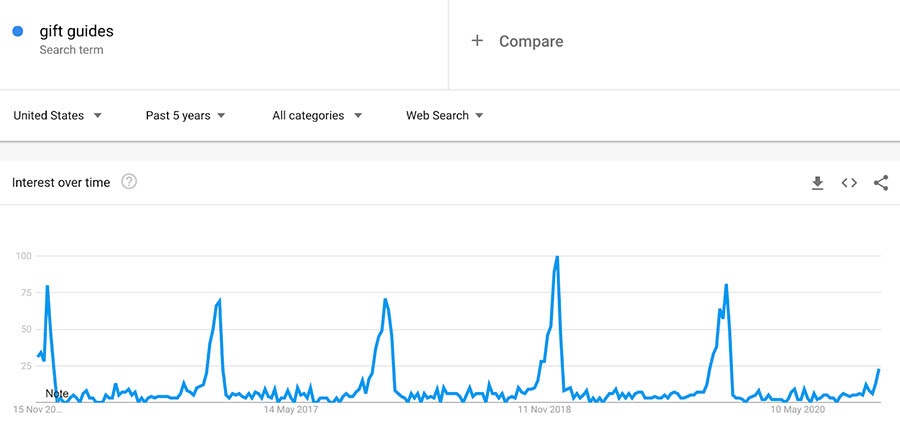
As a result, searches for “gift guides” peak a lot every December.

Example search result usage for ‘gift guides’ in December.
(Image credit)

Want to get in on some of that?

Promote your own products by writing themed, targeted gift guides. By this, we don’t mean writing generic “Christmas gift guide” posts. Write posts that are specific to a particular audience — i.e., for grandparents, siblings, partners, and so on.

19. Add your offers to coupon sites

Who doesn’t love a good deal? Especially when we’re on a holiday shopping spending spree!

Drive extra traffic and business by promoting your offers on coupon sites.

There’s a big list of coupon sites to sift through here — though there’s always going to be more, so you should do your own research too.

Just bear in mind that many coupon sites operate as affiliate sites. This means they take a cut of the revenue when they refer a customer that converts and that you’ll need to start an affiliate scheme to get featured.

20. Create a holiday-themed lead magnet

Lead magnets are incentives from marketers or site owners to their customers or potential customers, meant to capture their email address and (usually) a few other details.

Think free eBooks, cheat sheets, tools, printables — the options are pretty much endless.

The only real rules are that you need to be offering real, high-quality content, and payment should only be in the form of a user’s details.

They’re worth having on your website all year round, but why not dress them up for the party season and create an extra incentive for your visitors by designing a festive lead magnet or two?

Customer Support Ideas

21. Provide really excellent customer service

So you should be doing this all year round, but the (massive) uptick in shoppers leading up to the holidays means you need to be even more on the ball when it comes to customer service.

Consider things like:

  • A likely increase in customer inquiries: Do you have the resources to deal with them? And if not, how can you increase your customer support capacity?
  • Extending your returns policy — ideally well into January. Better yet, include a slip with purchases that their loved ones can use to discreetly and easily return them. This gives shoppers extra peace of mind that an unwanted gift (or the money spent on it) won’t go to waste.
  • Your customers’ most common questions: What are they? Drafting replies to these questions can be a huge timesaver and speed up how long it takes to respond to them.

22. Update your processes to help stressed shoppers

Continuing with the topic of customer service, remember that at this time of year, shoppers are going to be extra stressed. Especially if they’ve made the classic mistake of leaving gift buying to the very last minute.

Be prepared for a surge in orders as the big day draws closer. Make your final order date for guaranteed Christmas delivery (or any other holiday) crystal clear. And upgrade yours and your staff’s knowledge of products and processes so you can assist stressed shoppers as quickly and efficiently as possible.

Loosening up your processes a little is a very good idea too.

Whether a customer urgently wants something that’s out of stock or needs an item to arrive earlier than it typically would, do your best to go out of your way and accommodate their needs.

You’ll be thanked later in the form of customer loyalty.

23. Reward loyal customers with a gift or special offer

Want to build on the customer loyalty you’re creating by going above and beyond for them? Then why not reward them with a special gift or an offer they just can’t refuse?

For bonus points, personalize the gift or offer. This may not always be possible, especially during extra-busy periods, but use it if you have the capacity.

Valued customers are far more likely to return than customers who feel like a number in a machine.

24. Review and adapt your shipping policies

Thanks to a certain big e-commerce site, online shoppers have become increasingly accustomed to the idea of fast, free shipping.

If your average delivery time exceeds two days, and you’re charging delivery fees, you could be losing sales. Especially if you’re shipping small, lightweight items.

Multiple tests have been carried out on the impact of free shipping, with the average uptick in conversions being between 25–40%.

Yep — charging for shipping could be slashing your sales by up to 40%.

This is even more apt during the holiday season when shoppers are (often) strapped for cash. Slap them with an unexpected shipping charge, and a big order could quickly become no order.

“But what about revenue?” We hear you say.

“Our margins are tight anyway.”

There isn’t a perfect solution, but if your products are hard to find elsewhere, simply increase your prices slightly and absorb the shipping cost into them.

25. Increase the ways your customers can contact you

How can customers reach you? Not everyone wants to pick up the phone or wait for a response to an email. If you don’t already, consider offering support via live chat and social media.

Just make sure to manage your support channels so that when a customer contacts you via live chat or social, someone’s there to answer them.

Ready to Run a Holiday Sale?

Whether you need help creating a holiday marketing campaign, optimizing an e-commerce website, or creating a landing page, we can help! Subscribe to our monthly digest so you never miss an article.

Holiday Shoppers Are Waiting

There you have it: 25 ways to boost your sales throughout the holiday period (and in many ways, beyond). Choose and implement as many relevant suggestions as you can, and we’ll cross our fingers and toes that you’ll have your most successful winter ever!

The post 25 Simple Ways To Boost Holiday Sales on Your Website appeared first on Website Guides, Tips & Knowledge.


source https://www.dreamhost.com/blog/how-to-boost-holiday-sales-on-your-site/

Thursday, 3 December 2020

Longhand Pencils Creator Uses a DreamHost Site to Push Pencils and Pop Culture

There’s no denying it — this year’s been a rough one. We’ve all found ways to deal with the stress, from quarantine baking (and eating) to endless internet scrolling.

Kasee Bailey — Austin-based reader, writer, pop-culture fan, creator, and mom of four kids under age four (yes, you read that right) — found her 2020 happy place in reconnecting with the pieces of culture she loves most.

“In a really difficult year, it’s brought me a lot of joy and comfort to just get lost in something that makes me happy, rather than doom scrolling through social media,” she says.

Bailey gets to reread, rewatch, and rediscover the things she loves and call it work: Alongside freelance writing and chasing her two sets of twins, she runs Longhand Pencils, an online store offering up hand-stamped pencils that celebrate all things pop culture.

“Longhand Pencils grew out of a love for writing and for the things that connect us,” Bailey says. “If a whimsical pencil adorned with the lyrics of your favorite song or a quote from your favorite movie can encourage you to sit down, mute the endless notifications and siren calls of your inbox, then I’ve done something right.”

In a world that’s getting more and more digital, Longhand Pencils invites us to stop the scrolling and write something by hand, from a love letter to a grocery list.

“It’s a practice that is so beneficial for our mental, emotional, and physical well-being,” Bailey says. “So much of our diets are digital, so I wanted to create something fun and whimsical that could help people unplug and connect better with themselves and others.”

A year in, Bailey’s seen Longhand Pencils grow from its first customer — her mom — to dozens of pencil sets in the shop, collaborations with artists and authors, and a burgeoning following among the “bookstagram” crowd. Bailey also writes for the DreamHost blog and now uses the tips and tricks she curates for website owners to build her own brand. She’s evermore impressed with the tools DreamHost offers to help Longhand Pencils grow, keeping the technical side afloat and commerce simple so she can focus on her passion.

“Maybe pencils are so last century,” Bailey says. “But to me, they’re inspiration. They’re connection. They’re improved well-being. That passion ignites me.”

We’ll Support Your Dream

Whatever your online goals, we’ll be right there with you, making sure your site is fast, secure, and always up. Plans start at $2.59/mo.

Mounting an Analog Revolution

Blurry background with Bailey holding fist full of pencils in focus.

Bailey believes in a return to the unplugged, to be present apart from tech — in an analog revolution of sorts. Her passion for pencils is a big part of that.

“I believe that a pencil is timeless,” she says. “It represents connection with ourselves and others, a mindfulness that is so needed in our day and age. Call it analog or call it old-fashioned, but getting back to the good ol’ days of No. 2s and loose-leaf can help us access benefits absent in the clacking of keys, strings of abbreviated, emoji-laden messages, or the blinding light of screens.”

Before she became a pencil-pushing, writing-by-hand revolutionary, she was (and still is) a reader and a writer. Crafting words has been shaping force from childhood to college and career.

“As a kid, I filled collage-covered notebooks with details of my days, dreams, and the lessons I learned,” Bailey says. “Now, I scribble out stories and wishes, love and thank you notes, by hand, aiming to connect deeper with myself and the people around me.”

After earning a degree in journalism and working in communications, Bailey became a mom and found herself needing a flexible gig that fit both her skillset and her busy lifestyle. Freelance writing fit the bill.

“Not only did it allow me to stay at home with my children, but it helped me keep a foot in the door to my professional career,” Bailey says. “Starting a business inspired by writing and its tools has really been a natural outgrowth.”

Longhand Pencils is an easy marriage of her love for writing and a passion for pop culture — she’s a self-proclaimed “natural fangirl,” happily obsessing over stories she loves. Bailey is not the first to create foil-stamped pencils, but she wanted to make them herself, curating quotes from books, movies, TV shows, songs, and events that speak to her.

So she invested in her own hot foil stamping machine (it’s pretty fancy — check out her unboxing video) to make pencils celebrating her favorite things. It took months to master the intricacies of the machine, but once she got it down, she built a website and started selling.

“Combining pop culture and pencils is a dream,” Bailey says. “It’s such a special way for me to pay homage to the things I care about and connect with others.”

Crafting By Hand

Close-up of Bailey at work on her pencils.

Each pencil set, hand stamped at home with gold foil, is a labor of love.

Some include only one to three pencils, like her tribute to the Oxford comma or Leslie Knope’s favorite holiday. These shorter sets may only take 30 minutes to an hour. Longer sets — a 12-pencil Hamilton lyric collection, for example, and eight for Harry Styles — can take a few hours to complete.

“There was quite a learning curve when I first started using the machine,” Bailey says. “I’ve really had to discover all the various techniques for clean stamping, like adjusting screws, balancing the amount of pressure, and other minute details.” You can see her stamping in action on Longhand Pencil’s YouTube channel.

Bailey’s happy to spend the hours working by hand, making something for others to use by hand. She passes the time listening to music, watching shows, and listening to audiobooks — you know, research.

“I’m always engaging with something,” she says. “Most recently, I’ve been re-listening to the Boyfriend Material audiobook, the American Girls Podcast, and Broadway soundtracks.”

Fueling Fandom

Drawing from pop culture and current events gives Bailey a natural audience for her stamped pencils: fellow fans.

“Because my pencils are pop culture-focused, people like to geek out with me over whichever movie or show or book I’ve based the set on,” Bailey says. “I’ve loved getting to connect with different communities of fans, as well as other paper people who love stationery and office supplies as much as I do.”

Anything can inspire a set, from a vice-presidential debate to a K-pop band. Some of her favorites to make have been homages to Golden Girls, Schitt’s Creek, Hamilton, and You’ve Got Mail — though, she adds, these have been the hardest to choose quotes for. One of the first she’s made is another favorite, a set honoring YA author Sarah Dessen.

“Her books meant so much to me growing up and have really impacted me as a writer,” Bailey says. “I loved paying homage to her in that way.”

Longhand Pencils has recently found a strong audience in “bookstagram” — a corner of the internet for readers and book lovers — especially YA romance fans. “I love that,” says Bailey, who is slowly but surely working on her own teen novel. “These are my people.”

Her book-based sets are top sellers: She has a set honoring LGBTQ romances by Rainbow Rowell and others, classics like Anne of Green Gables, and a collaboration with author duo Christina Lauren. One of the most popular pencil sets lists favorite tried-and-true romance tropes — a huge hit in Romance Land-ia.

“Everyone has been so kind about my pencils, and I love seeing people enjoy them,” Bailey says. “Sometimes I’ll get people commenting things like, ‘Oh, why didn’t you include this quote?’ or ‘You missed my favorite line!’ which is hard because truly, the hardest part for me is picking which phrases to include in a set. I’m sometimes limited by the length or complexity of a quote, and having to narrow down a movie or show into only a handful of pencil quotes is so difficult. I just try to do my best and make each set a fun representation of whatever inspires it.”

Collaborating and Connecting

Building and running a brand-new small business is no easy feat, as Bailey quickly discovered.

“There is so much to running a small business — the biggest being that you have to wear all the hats, especially at the beginning,” she says. “You’re the marketing team, the salespeople, the accountants, the maker. So you have to really be passionate about it and celebrate the small wins to keep going.”

To stay positive, she’s adopted the learn-on-the-fly mentality of “start before you’re ready,” throwing herself into the work and giving herself grace when she makes mistakes.

When Longhand Pencils first launched, Bailey spent hours messaging social media influencers, asking them to share her products, and put lots of money into advertising. She’s since figured out more effective marketing techniques that fit her niche.

“I listen more to my customers and what they want, and I embrace the social media platforms in the ways that they’re most successful — connecting with bookstagrammers on Instagram, authors on Twitter, and fandoms on Tumblr, etc.,” Bailey says. “I try to work with other people as much as I can so that by collaborating, we can leverage the power of our joint communities. Even online, word of mouth is a big deal!”

Collaborations have become a big part of Bailey’s work in promoting the business. She’s worked with designers, artists, makers, and others to create new products for her shop and offer giveaways. With her growing bookstagram following, she’s started working more with authors to share sets connected to their books — and she pulls out her own writer’s hat with a series of interviews on the Longhand Pencil blog, which she uses to introduce authors and amplify the work of other creators.

“I’m really proud of what I’ve built in a year,” Bailey says. “I have grown my business in big ways over a short span of time, and have watched myself grow and learn immensely. I successfully opened my store for wholesale, hand-stamped more than four thousand pencils in a three-day period for a business, and have networked with some incredible entrepreneurs and creatives. I’ve expanded my product line, built and connected with a customer base, and found something that combines my passions. I love what I do and can make money from it, so I’m really proud of being able to accomplish that, even though I knew next to nothing when I started.”

Drinking the Kool-Aid

As a writer for the DreamHost blog, it wasn’t a hard choice when Bailey needed a host for her personal writing portfolio and blog.

“I’ve been writing for DreamHost for a couple of years and using their hosting services on my personal website; I’ve always been really impressed with their services, support, and base of knowledge that they share with the tech world,” Bailey says. “So when I created my business, it was a no-brainer to host that site with DreamHost, too.”

Bailey appreciates that DreamHost services can scale and grow with her business. She started with a basic shared hosting package, upgrading to DreamPress as Longhand Pencils gained traction.

“I love the staging services, so I can test out new elements on a practice site before I push it live,” she says. “Also, on my business birthday, I was prepping for a sale, and my site was experiencing some downtime. I reached out to DreamHost support and immediately got to chat with someone who helped me work through the issue and get my site back up and running.”

Aerial view of Bailey's hands as she works on pencils.

The bread and butter of any e-commerce site is making it easy for customers to find and buy your products. Bailey was familiar with WordPress but new to selling online and found it simple to integrate WooCommerce into her site and create an easy shopping and checkout process.

“I’ve really worked hard to make my website functional and attractive,” Bailey says. “It’s taken some time to get right (these things do!), but I am really pleased with how it’s come together. I love that it’s easy to navigate and that it’s fun to explore. I want anyone who visits it to find something they love, and not have any frustrating barriers to shopping — like slow load time or confusing navigation.”

DreamHost, she says, takes some of the burdens off her full plate as a small business owner, offering technical support and simplifying the e-commerce side of things. “I can focus on the parts of business I am most passionate about and not have to sweat the tech tasks that can be really complicated and time-consuming.”

Want to Meet More Awesome Site Owners?

Subscribe to the DreamHost Digest for inside scoops, expert tips, and exclusive deals.

Shopping Small, Dreaming Big

Kasee Bailey at work on her pencils.

Bailey and other creators are gearing up for the holiday shopping season. In a year that’s been tough, to say the least, spirits are down, and handcrafted gifts can go a long way in supporting a friend — and a maker.

“It’s been such a difficult year for small businesses,” Bailey says. “People have less money to spend, and the economic environment is less than ideal. It is as important as ever to shop small and support the real people behind the businesses in our communities.”

Dollars matter, she adds, and where we put them shows what we value. Instead of giving more of yours to big box stores, consider investing in creativity. “Plus, who wants a boring run-of-the-mill gift for the holidays? Shopping small means unique, creative gift-giving that will make you a family favorite!”

As the year finally winds down, Bailey is focused as ever on growing Longhand Pencils, on wrangling her little twins — with all she has going on professionally, she considers parenting her full-time job — and working through her TBR stack.

“I’ve been reading a lot of romance books this year, because 2020,” she says. “It’s been a wonderful escape. I’ve also been working to read a lot more from women, BIPOC, and LGBTQ+ authors.”

Amid guilty-pleasure streaming and rewatching this year’s Emma remake and Hamilton on Disney+, Bailey celebrates her business’s first birthday by looking to 2021 with no limits.

“This past year, I’ve learned to dream big. So many really amazing things have happened for my business — things that I never could have imagined when I started. So in the coming months and years, I don’t want to limit myself. I want to dream big — exciting collaborations, new products, and LOTS more pencils!”

The post Longhand Pencils Creator Uses a DreamHost Site to Push Pencils and Pop Culture appeared first on Website Guides, Tips & Knowledge.


source https://www.dreamhost.com/blog/customer-spotlight-longhand-pencils/

Tuesday, 1 December 2020

How Your Online Business Can Nail Customer Service During the Holidays

The holiday season is upon us once more, and that means many things for your business. On the one hand, you’re about to enter the most lucrative period of the year. However, you’ll also be considerably busier than usual, and will likely need to deal with a much higher number of customer support queries.

To make sure your support can cope with the holiday rush, you’ll want to plan ahead. Strengthening and preparing your support team is key to helping them provide assistance for a huge influx of stressed customers. If you do that, you’ll be able to reap the benefits of the season more effectively.

In this article, we’ll discuss why it’s particularly important to think about the customer experience throughout the holidays. We’ll also offer some tips for how you can prepare your business and support employees in advance. Let’s get started!

Why Customer Service Matters Most During the Holidays

If you’re anything like us, you’re getting busier by the day preparing for the holiday season. However, this isn’t just a time for buying gifts and eating good food. It’s also the most critical period for businesses, as many retailers and service providers make the bulk of their yearly sales during the last few weeks of the year.

However, to make sure your business takes full advantage of this period, you’ll need to plan ahead carefully. There are plenty of ways to ensure that you’re ready for the holiday rush, and one of the most crucial is making sure your customer service will function flawlessly.

Of course, providing high-quality customer support is always necessary. During the holiday rush, however, you will most likely be inundated with even more support queries, questions, and confused customers than at any other time of the year. And because of stress levels, you’re also more likely to end up dealing with some frustrated and potentially antagonistic customers.

This might sound intimidating. By preparing in advance and making a solid plan, however, you can ensure that your customer service will remain top-notch even under less-than-ideal circumstances. Not only will this help your customers, but it will be a huge benefit to you and your customer service agents as well.

Your Site’s Home for the Holidays

We'll make sure your website is fast, secure, and always up so your visitors trust you. Plans start at $2.59/mo.

10 Ways to Prepare Your Customer Service for the Holiday Rush

If you’re wondering: “When should I start to prepare for the holidays?”, our answer is right now! It’s never too early to start planning for the year’s final month, but having a plan in place at least by the beginning of December is highly recommended.

With that in mind, we’re going to guide you through some of the most important steps you’ll want to take. Here are 10 things you can do to prepare your customer service before Santa arrives!

1. Analyze Last Year’s Data

A perfect place to start your planning is to look back at the previous year. This will involve examining the volume and type of customer interactions you received, finding out what the most common pain points were, and trying to understand where your service may have been lacking.

Having this data at hand will be a huge help when formulating a plan for the upcoming rush. You’ll be able to improve in areas where you’ve struggled previously, and you can also preemptively provide information for the most common customer questions. In turn, this will cut down on the number of queries your team has to field.

How you go about doing this analysis will naturally depend on your toolset. If you’re using software like Zendesk or Awesome Support, you can just view the statistics and queries from previous years. You should also liaise with your support and marketing teams, as they’ll be best equipped to tell you where you need to focus your attention.

Here are some vital questions you’ll want to be able to answer:

  • How much larger is the volume of support queries you receive during the holiday shopping period, compared with the rest of the year?
  • What are the most common questions customers have?
  • How are most people choosing to contact you — via email, phone, chat, or some other medium?

Of course, this is by no means an exhaustive list. However, these answers will help you immensely throughout the rest of your preparations.

2. Decide Which Support Channels to Focus On

It’s essential that you know where to focus your attention during the holiday season. At first glance, it might seem like the best route to use every conceivable method of contact, but this can lead to spreading yourself too thin.

Imagine that you have to simultaneously juggle phone lines, live chat, emails, and social media, in addition to updating your content and dealing with orders and shipping. In this scenario, you’ll likely see most — if not all — of those channels suffer in quality. This is especially true if you only have a small support team.

To avoid this problem, you’ll need to consider which channels of communication to focus on. The best way to start is by looking at which channels are most commonly used by your customers. As we mentioned in the previous section, looking at earlier years’ support queries will give you a good baseline to work from. However, you’ll also want to consider which channels are most popular during the rest of the year.

For example, if you find that your customers are primarily calling in or using your contact form throughout the year, it’s fair to assume that these will be the busiest channels during the holidays as well. Knowing this will let you assign more people to handle those channels, and avoid keeping customers waiting.

3. Prepare for Quick Scaling

The truth is that no matter how well you plan, the holidays are never completely predictable. This means you’ll need to have a contingency plan, in case you need to scale up or down with little notice.

For example, what if you face twice as many support requests as you anticipated? You’ll need to be able to assign more time and manpower to deal with them, while also keeping the rest of your operations afloat. In this scenario, you might consider hiring remote seasonal workers to help out.

This is something many companies do to handle the increased volume of work during the holidays. Hiring temporary workers gives you the freedom to change the size of your team at almost a moment’s notice. For example, you could use a service like PartnerHero to outsource some or all of your customer support work during this period.

Naturally, you’ll need to ensure that these seasonal workers have all the assets and information they need, which is something we’ll discuss later on. With the right preparations in place, they should be able to slot into your normal operations with little friction and help you deal with almost any unexpected situation.

4. Keep Your Customers Informed

Arguably the most significant way to avoid customer frustration is to manage their expectations. If your support is changing during the holidays, you need to make that clear as early as possible. They’ll need to be aware of when and how they will be able to contact you.

It’s also smart to let customers know how your other operations are likely to alter. For example, will returns take longer to process, and will they need to wait a bit for responses to their emails? By letting them know what to expect, you can keep them informed and minimize the risk of frustration or hostility.

One strategy you can use to your advantage is sometimes referred to as “underpromise and overdeliver.” The idea is that you prepare customers for potential issues that may arise, but then work to avoid those problems anyway. This lets you exceed their expectations.

Overall, our recommendation is to be honest about what customers can expect and to make any changes clear through as many channels as possible. That includes your website, social media, and even your email list. This will ensure that the bulk of your customers know what to expect.

5. Use Automation to Your Advantage

When the season gets going and you find yourself swamped in tasks, every second will count. To make sure you can use your available time most efficiently, you’ll want to consider automating tasks whenever it’s possible to do so.

For instance, you can create an automated workflow using software like Help Scout. This can be set up to redirect customer queries to the person or team best suited to deal with them. Not only will this save time on your end, but it will also keep waiting times down for your stressed customers.

Workflows also let you handle plenty of other tasks automatically, such as tracking products to let you know right away when stocks are low. You can then deal with the potential issue before it becomes a full-blown problem.

There are plenty of other ways you can use automation during the holidays. One of the best strategies is to set up an AI-driven chatbot that can help you deal with the most common questions. This can dramatically cut down on the amount of time the human members of your team need to spend on customer support requests.

Be Awesome on the Internet

Join our monthly newsletter for tips and tricks to build your dream website!

6. Implement a Triage System for Support Queries

In addition to automating parts of your support system, you can also optimize it by introducing a triage process. This involves sorting tasks and support queries into categories depending on their urgency. You can then prioritize more urgent matters first, while non-emergency tasks can be dealt with later.

Triaging your customer service requests will let you focus your attention on what matters most at any given time. The most pressing and time-sensitive tasks can be dealt with right away, minimizing the risk of making your customers feel frustrated and hostile.

An easy way to do this is to simply categorize each customer query according to priority. If an issue needs to be dealt with immediately, you might label it as “critical,” while if it needs to be looked at within 1-2 hours it could be labeled “urgent.” Issues that can wait a day or two, on the other hand, can be noted as “low priority.”

However, you need to remember that you’ll still have to actually deal with all requests. If you find that you’re never getting around to handling low-priority tasks, you may need to consider scaling your team up temporarily by assigning additional personnel.

7. Update Your Content and Knowledge Base

Earlier, we discussed the importance of keeping your customers informed. However, this extends beyond just letting them know about changes to your schedule. By making sure that all of your content and assets are up-to-date, you can save both customers and yourself a lot of time and hassle.

For example, if you provide a knowledge base with information about your products and services, you can use it to answer most of the most commonly asked questions during the holiday period. In many cases, your support team can simply refer customers to relevant knowledge base articles, answering their queries quickly.

For this to work, you’ll obviously need to ensure that you provide as much documentation and information as possible. It also needs to be thoroughly updated, to ensure that you don’t cause additional confusion among your customers.

If you need to set up a knowledge base, you can use a plugin such as Heroic Knowledge Base. If you already have one, on the other hand, you should perform a content audit well before the holiday rush kicks in. This can also involve reviewing similar resources, such as your FAQ page.

8. Learn How to Help Stressed Customers

The holidays are intended to offer relaxation and fun, but we all know that it can also be a thoroughly stressful period. As such, you’re likely to deal with a few customers who are particularly difficult, frustrated, or even outright antagonistic. The good news: As an online business, you won’t have it quite as bad as brick-and-mortar retailers.

Either way, you’ll need to prepare in order to help customers out and avoid angering them further. Dealing with difficult customers is a delicate task. The most valuable advice we can offer is to train your support team to stay calm and professional at all times, no matter what a customer might say.

In addition, here are some ways you can approach particularly challenging customers:

  • Listen. If the customer feels like they’re being deflected or ignored, they’re only going to get angrier and less responsive.
  • Be quick. Naturally, your goal is to be as fast as possible with all support queries. However, it can be worth prioritizing more stressed customers, to avoid further incident.
  • Treat them like people. We discussed the value of automation earlier, but in tough cases, it’s better to take a personal approach. Make it clear to the customer that you’re handling their issue and care about their frustration, so they don’t feel like they’re being treated as a nuisance.

In short, by listening to the customer and being prepared to meet them halfway, you can usually solve even the most heated of issues.

9. Prepare to Provide Compensation to Customers

In some situations, you may need to compensate customers. Especially in the most volatile or challenging cases, a simple gift can help to smooth things over immensely. Some customers might even demand this kind of treatment.

Providing compensation can help to soften even the most upset customers. It can also win back some goodwill. Your goal is customer retention with the hopes that the customer will consider using your business again in the future, despite their current grievances.

Naturally, you’ll want to be very careful about how and when you compensate customers. In some cases, such as when they’ve received a faulty product, you may be legally obligated to provide a new item or a refund.

However, you can also provide compensation if a customer has had a particularly difficult experience, either with your business or your customer service. This could be in the form of a small gift, a coupon, a discount, or anything else that’s convenient but useful to the customer.

10. Take Care of Your Support Team

Finally, while it’s obviously necessary to take care of your customers, you shouldn’t ignore the people on your own front lines. Beginning on Black Friday and Cyber Monday, the holiday rush is a stressful experience for everyone, especially those who have to field questions and requests from wound-up customers.

Depending on the size of your business, you can take care of your support team in several ways. Naturally, you should make sure they have everything they’ll need to do their jobs without incident.

However, it’s also nice to reward your support team further, to show your appreciation for all their hard work. Even something as simple as the occasional gift, like seasonally appropriate sweets and drinks, can do a lot to raise morale during this hectic season.

Customer Satisfaction Made Easy

The holidays are meant to be a time of joy, but it can be hard to feel merry if your customer service is strained. By preparing well in advance, you can put a plan into place, train your team, and inform your customers — providing effective and efficient support as a result.

Need to take your website to the next level for the holidays? DreamHost makes it easy. Leave migrating your site, managing security and updates, and optimizing server performance to us. Now you can focus on what matters most — growing your business. Check out plans today!

The post How Your Online Business Can Nail Customer Service During the Holidays appeared first on Website Guides, Tips & Knowledge.


source https://www.dreamhost.com/blog/how-your-online-business-can-nail-customer-service-during-holidays/

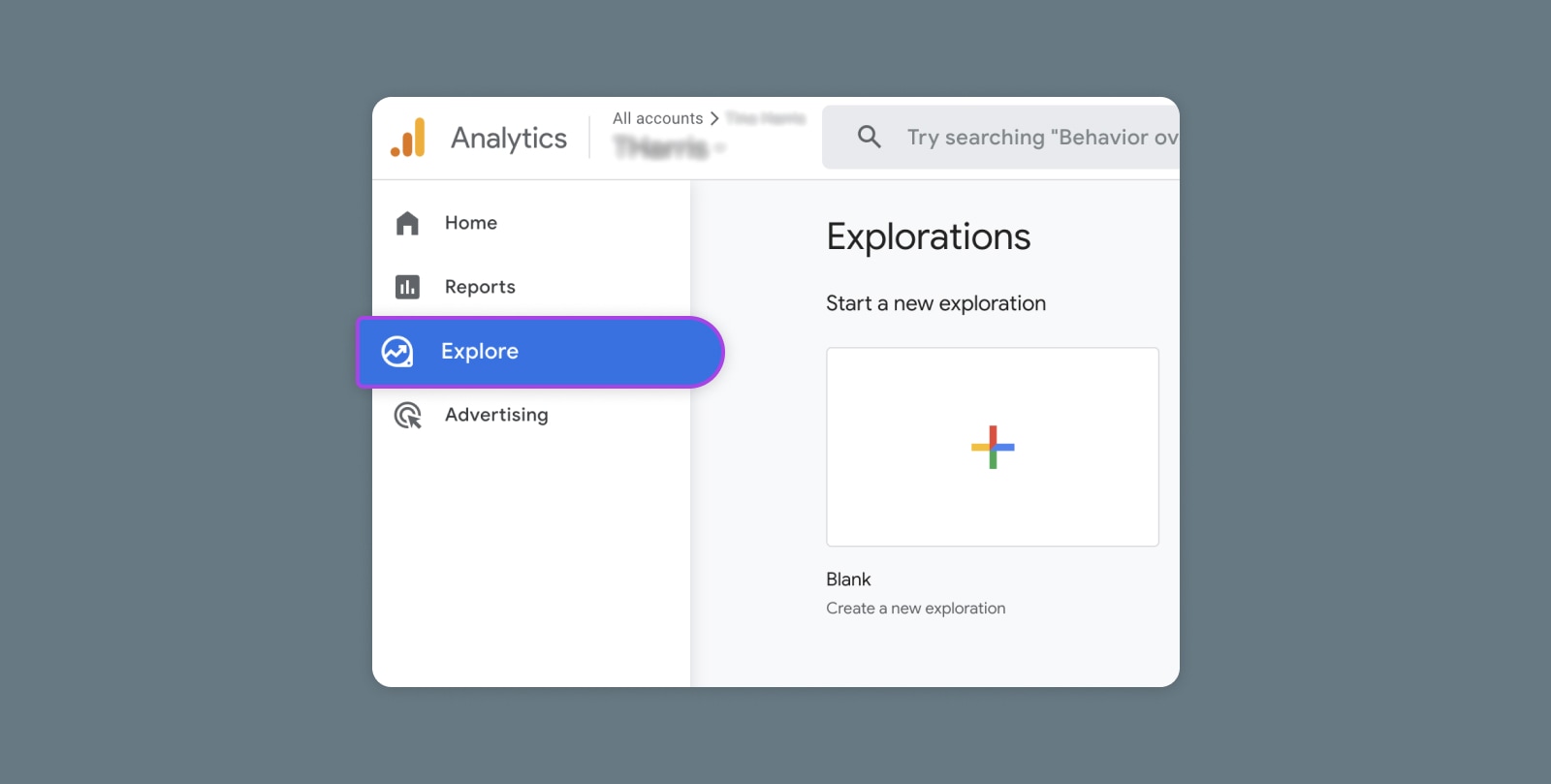
Creating and Mastering GA4 Explorations

In the switch from Universal Analytics (UA) to Google Analytics 4 (GA4) — which will go fully into effect July 2023 — a lot of things have...